Ask Your Org: A GitHub Native Company Brain
A governed organizational knowledge system that turned scattered company context into a navigable GitHub structure with explicit sources, ownership, freshness, and escalation rules.
- Architecture layers
- 3
- Always on files
- 5
- Connector domains
- 7
- Decision layer
- Frontier
Ask Your Org was a separate system built alongside the GTM platform. It was a GitHub native company brain designed to help employees and agents answer organizational questions without pretending that every document was equally current, authoritative, or safe to use.
The goal was not another chatbot over a folder of files. It was a routing and judgment layer for the business: what the company means by a term, where the canonical answer lives, which source wins when two sources disagree, who owns the decision, and when the system must stop and escalate.
The architecture
The blueprint separated organizational context by how quickly it changes:
- Description: culture. How the assistant thinks, speaks, cites, asks for clarification, and respects hard rails. This changes with the company identity.
- Files: structure. The company vocabulary, source map, people, ownership, and priorities that should be present in most conversations. This changes with the organization.
- Connectors: operational reality. Live documents, conversations, tasks, CRM records, performance data, and assets. This changes in real time.
The operational test was simple: if it changes when tools, people, or priorities change, it belongs in a file. If it changes only when the company identity changes, it belongs in the description. If it changes as work progresses, it belongs behind a connector.
Under all three layers was the essential foundation: source of truth discipline. The system had to know where a category of information lived, how it was named, who owned it, and how a question should be routed there.
Conceptual knowledge flow
From operational reality to governed agent context
People and live systems contribute signals. The Company Brain resolves them against structure, provenance, and ownership before an agent answers or routes.
- People & systems
Documents, decisions, work, metrics, and the humans responsible for them.
- Company Brain
Canonical structure, source mapping, provenance, ownership, and permissions.
- Governed agent
An answer grounded in sources, a conflict warning, clarification, or human handoff.
Take the architecture with you
Get the public Ask Your Org Blueprint.
A 23 page reference architecture covering the three layer model, five file standard, source of truth discipline, connector audits, permission boundaries, and implementation scorecard.
Repository evidence
A company ontology people can inspect
The repository was structured as a navigable operating system, not an uncurated document dump. Sensitive source URLs have been removed from the public evidence.
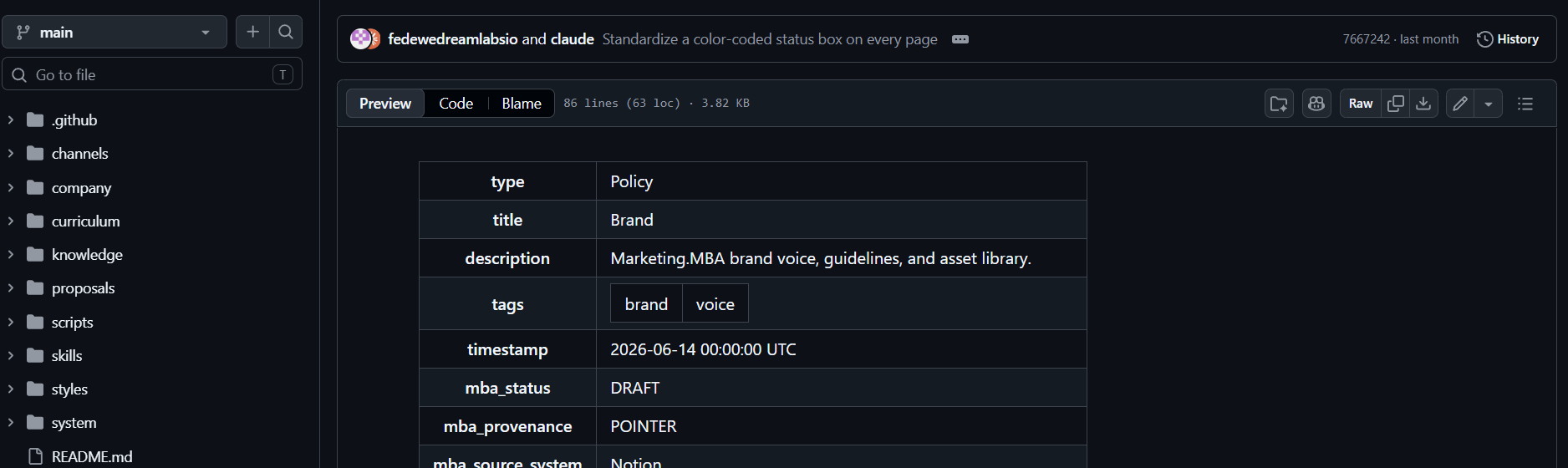
The root taxonomy separated channels, company context, reusable knowledge, proposals, scripts, skills, styles, and system rules so agents could reason about location before retrieval.
Open full size evidence →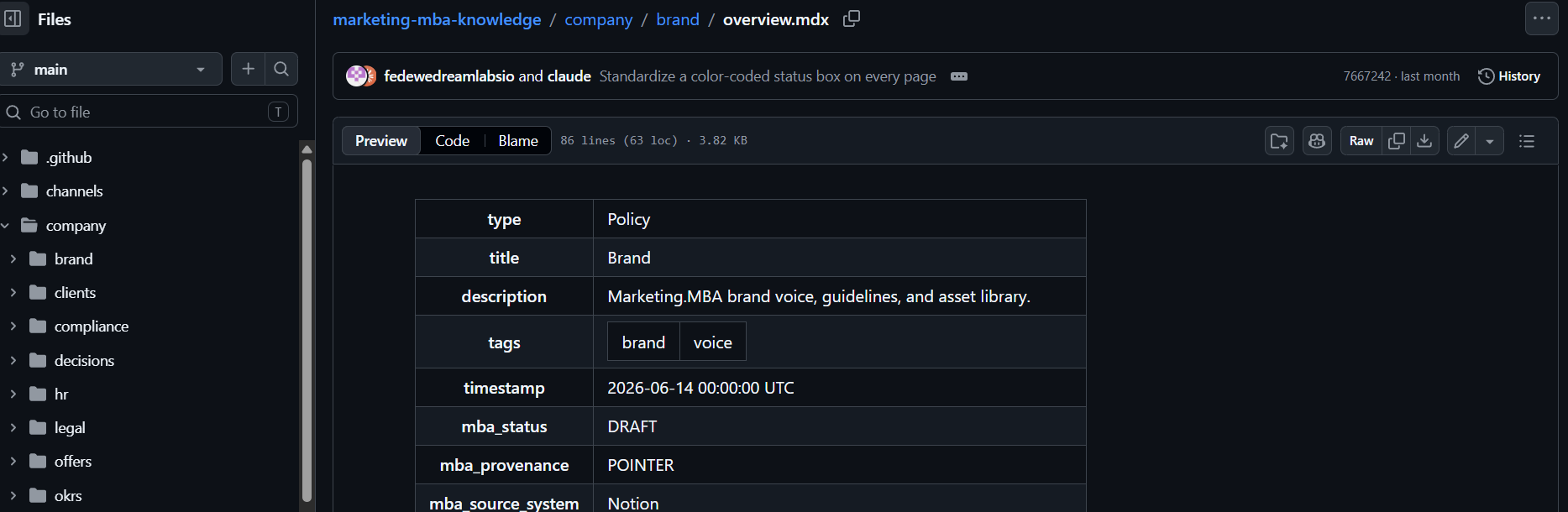
The company domain mapped brand, clients, compliance, decisions, HR, legal, offers, objectives, people, tools, and other recurring areas of organizational truth.
Open full size evidence →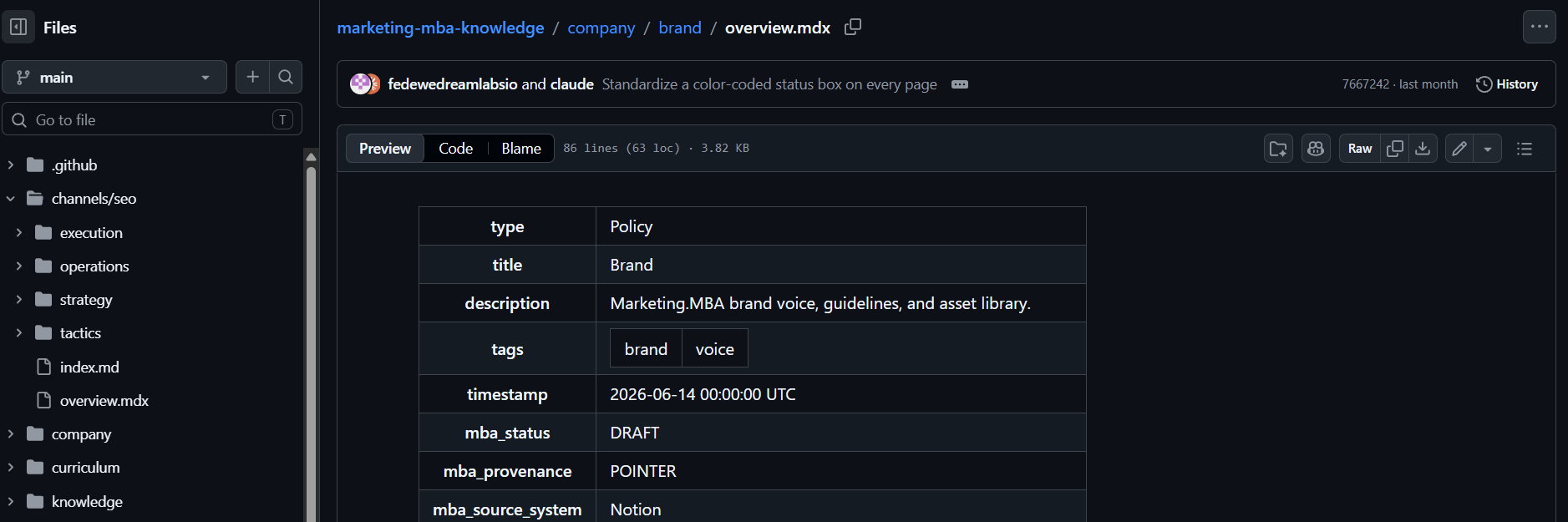
Channel knowledge was separated into execution, operations, strategy, and tactics. That made retrieval more precise and gave agents a stable path from policy to work.
Open full size evidence →The metadata visible in these pages was part of the architecture: type, status, provenance, source system, owner, and time. A page could point to Notion as the operational source rather than duplicating its contents and quietly becoming stale. GitHub supplied history, review, and inspectability; the source system retained operational ownership.
The five file standard
Permanent context is expensive. Uploading everything makes retrieval less reliable and increases the chance that old or sensitive material gets treated as current truth. A file earned permanent context only if it was broadly useful, stable enough, compact, and structurally important.
The blueprint reduced that layer to five files:
- Company overview: business model, offers, scale, leadership, and the facts a new operator needs on day one.
- Glossary: internal acronyms, framework names, product names, codenames, and terms the company uses differently from the market.
- Source of Truth Map: recurring question type → canonical system, including tiebreakers where tools overlap.
- People & Roles Directory: decision domain → durable role → current owner, so an answer can become a routed action.
- Quarter Priorities: current objectives, measurable targets, team priorities, owner, and refresh date.
Everything else stayed in its natural system and was retrieved through connectors that respected permissions. Full playbooks, frequently changing SOPs, sensitive contracts, salaries, and personal notes did not belong in permanent context.
Engineering decisions
Model authority, not just content
- Constraint
- A semantic search result can be relevant and still be wrong, stale, or outside the canonical source.
- Decision
- Attach status, provenance, source system, owner, and time to organizational knowledge, then encode which source wins for each question type.
- Consequence
- The system could surface disagreement and route to an owner instead of silently choosing the most convenient document.
Use pointers where reality already had a home
- Constraint
- Copying live business data into a knowledge repository would create immediate drift.
- Decision
- Let the GitHub page describe the policy and point to the operational source, such as Notion, ClickUp, Slack, or a CRM, for the current record.
- Consequence
- The repository became a map of company truth rather than a competing source of truth.
Make escalation a successful outcome
- Constraint
- Legal, financial, client facing, HR, and ambiguous questions should not receive a plausible autonomous answer.
- Decision
- Encode hard rails, confidence gaps, named ownership, and a single clarification question protocol in the assistant behavior layer.
- Consequence
- A safe answer could be a citation, a conflict warning, or a handoff to the right human instead of forced completion.
Connectors as operational reality
The connector plan covered seven domains: documents and knowledge; communication and decisions; tasks and operations; customer and pipeline; performance and data; creative assets; and custom internal systems.
Connectors were not interchangeable search boxes. Each existed to answer a different class of question with the right permission and freshness. A process question might route to ClickUp, a strategic framework to Notion, a recent decision to Slack with owner confirmation, and a client commitment to a human rather than an interpretation.
That is how the system moved from retrieval to organizational judgment:
Interpret → locate → retrieve → judge → output
The forward deployed part
The difficult work was not drawing the folder tree. It was getting people to decide what was actually canonical. Which system wins when Slack contradicts Notion? Who owns a policy after a role changes? Which source contains client commitments? What is confidential? How recent must a decision be before it requires confirmation?
Those are organizational conversations disguised as AI implementation. The company brain became useful only when employees and leaders confronted them directly.
Research boundary
Alongside the production knowledge architecture, I explored a custom decision ontology that represented recurring decisions as a trigger, evidence set, logic check, options, action, approval gate, and outcome metric.
That work was research, not a production capability. It is separated from the concrete knowledge architecture and repository claims above and is not presented as an autonomous management system.
What this system proves
Ask Your Org shows a different part of enterprise agent engineering: institutional knowledge, governance, provenance, permissions, and human routing. Agents become more useful when the organization becomes legible to them. The process of making it legible often improves the organization itself.
Public blueprint
Build the context layer before scaling the agents.
Use the blueprint to assess your current setup, then start a conversation if you want to map it onto a real organization.