Flagship case study · Production system
Building an Enterprise Multiagent GTM Operating System
The agent platform behind production GTM work: an internal agent factory, structured company context, specialist teams built for long runs, versioned skills, observable execution, approval gates, and business integrations.
- Agents developed
- 20+
- Frameworks in production
- 5+
- Stable run horizon
- 1h+
- Runs traced
- Thousands
REMI was not one clever prompt or one fixed workflow. I designed the operating layer for building and running specialized business agents: structured onboarding, manager and worker roles, versioned skills, tool access, durable execution, persistent artifacts, human approval, and integrations into the systems employees already used.
The point was to move from “an agent can generate this” to “a business can operate this.” That required architecture, but it also required forward deployed engineering: sitting with employees, watching where the system collided with incentives and handoffs, and having the difficult conversations that only appear after a demo meets real work.
The scale figures above describe the broader production profile around this work. The interface evidence below documents the system architecture; it is not presented as aggregate telemetry for those figures.
The business problem
Marketing teams were sitting on real assets: research, positioning, customer psychology, campaign history, and brand knowledge. Those assets did not reliably become executable output. Context lived across people and tools. Every handoff lost detail. Production depended on whoever could reconstruct the business in their head that week.
The first challenge was generation. The durable challenge was everything around it: context, authority, observability, recovery, integration, and adoption. A production agent needed to know what it could do, where truth lived, what evidence it had created, when it had to stop, and which human owned the next decision.
The operating system
System architecture
A GTM operating system, not a content generator
Company knowledge and live signals move through orchestrated agents, explicit human authority, operational execution, and a measurable learning loop.
At the center was a strategist designed for long runs. It could spend an hour or more moving from research to positioning and campaign strategy, then hand work to specialists. Splitting the work was not cosmetic: one agent trying to carry company context, research, planning, asset production, and tool state eventually became incoherent.
Context retrieval evolved through three real generations: vector search, a graph model, and finally a filesystem and repository layer. The last approach made company knowledge inspectable, versionable, and easier for both humans and agents to navigate. That work later expanded into the separate Company Brain case study.
Public blueprint
Make organizational context an engineered layer.
The Ask Your Org Blueprint turns these company context lessons into an architecture for sources, ownership, permissions, and escalation that applies across platforms.
System evidence
The platform, not just its outputs
Four product surfaces show the operating model: agents are configured, grounded in company context, composed into workflows, and connected to real business systems.
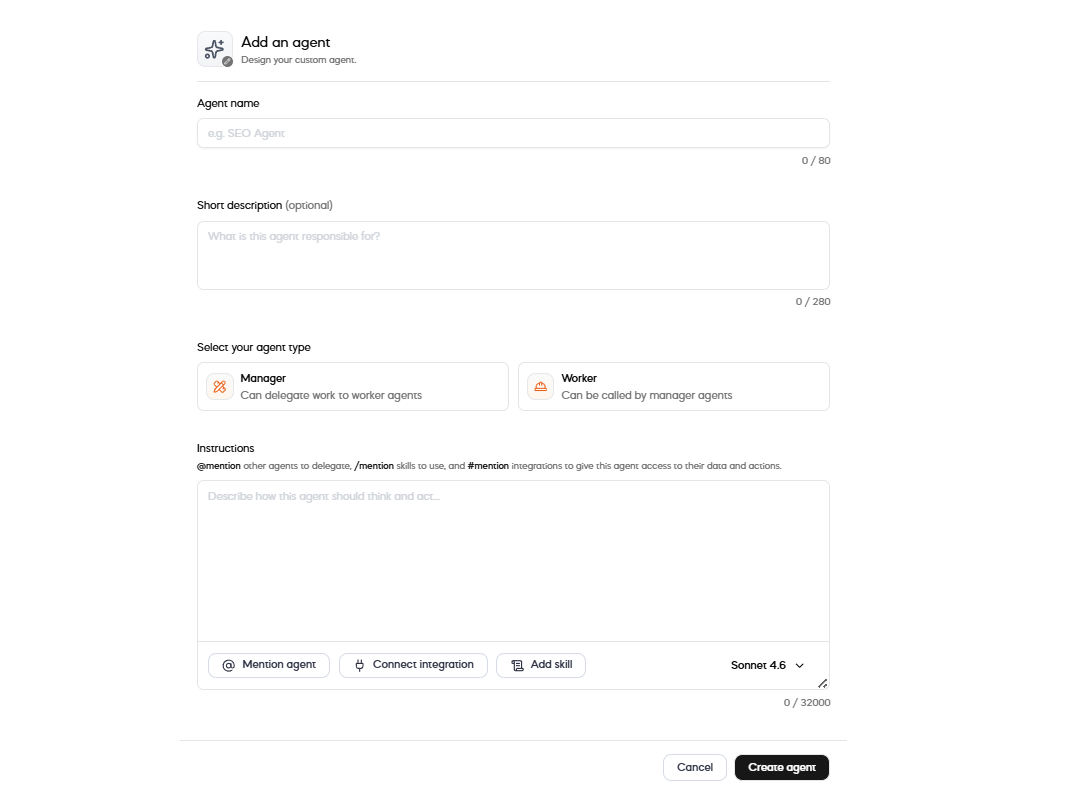
New agents could be created as managers or workers, then equipped with instructions, specialist agents, integrations, skills, and an explicit model choice.
Open full size evidence →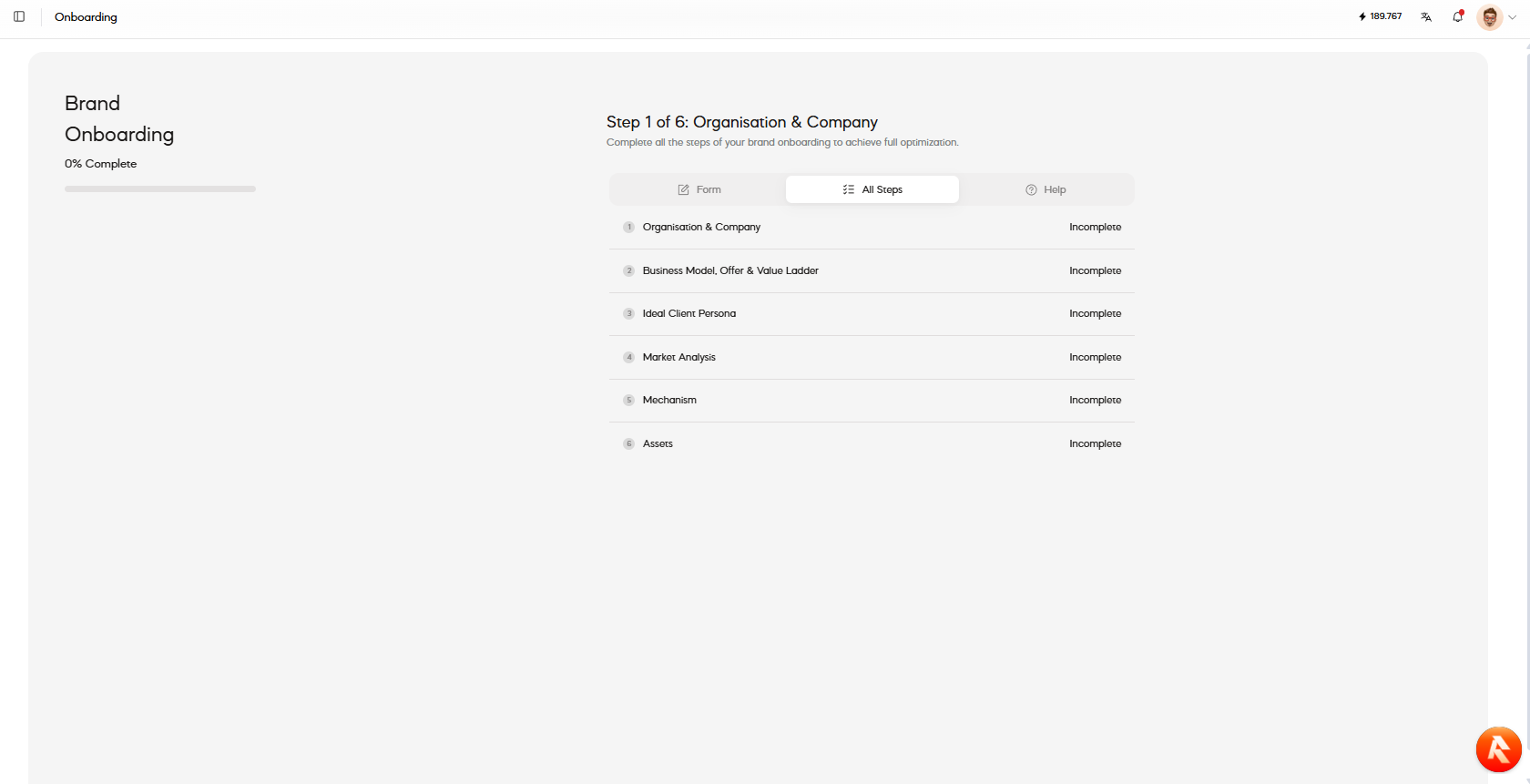
A six stage onboarding flow captured the organization, business model, offer, ideal client, market, mechanism, and source assets before agents were expected to act.
Open full size evidence →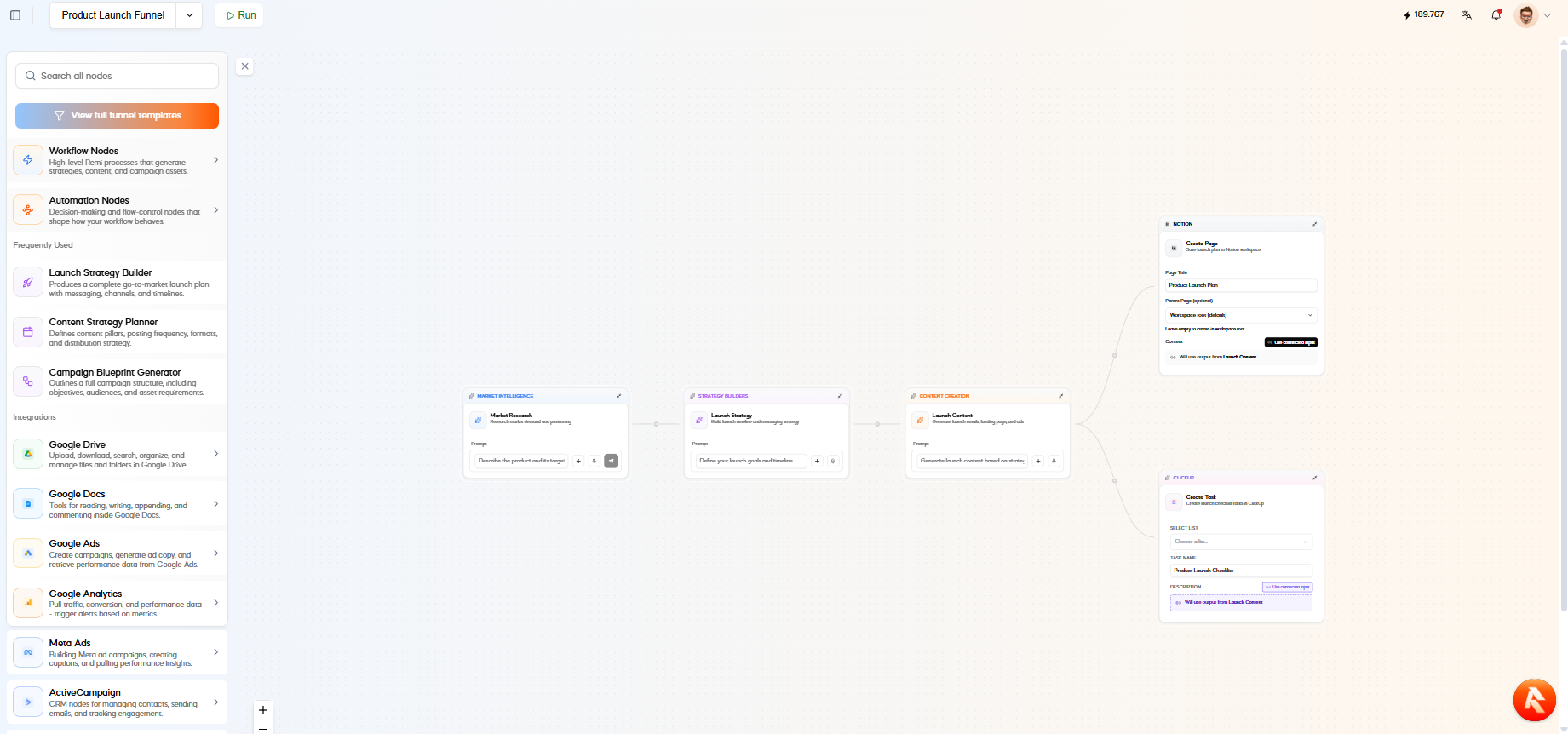
The workflow surface connected research, strategy, and content agents to downstream tools such as Notion and ClickUp without collapsing every responsibility into one prompt.
Open full size evidence →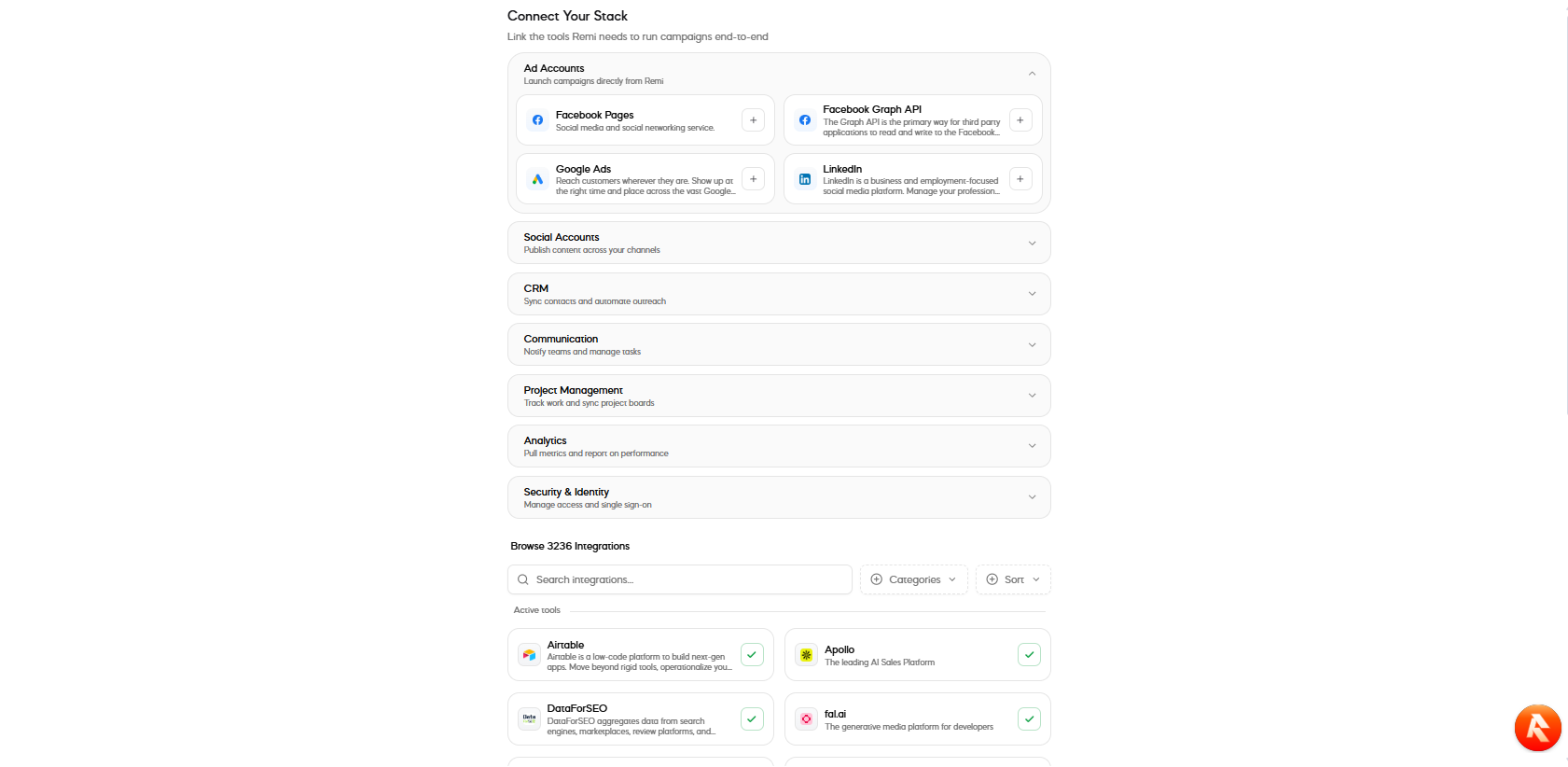
The integration layer covered advertising, CRM, communication, project management, analytics, identity, and active tools including Airtable and DataForSEO. The catalog shown is a platform capability, not a claim that I personally implemented every connector.
Open full size evidence →Engineering decisions
Build a factory, not another fixed automation
- Constraint
- The company needed different agents for different clients, GTM channels, tools, and authority levels.
- Decision
- Make agents configurable from manager/worker topology, instructions, model, skills, integrations, and delegated specialists.
- Consequence
- New production cells could be assembled without rewriting the runtime for every use case.
Treat skills as versioned operating contracts
- Constraint
- Prompts were becoming large, coupled, and difficult to improve safely.
- Decision
- Move repeatable procedures into named, versioned skills with explicit inputs, outputs, and forbidden actions.
- Consequence
- Capabilities could evolve independently, and authority boundaries became inspectable rather than implied.
Separate canon, workbench, and memory
- Constraint
- Agents operating over long runs needed durable context without turning every recollection into organizational truth.
- Decision
- Use repositories for canonical knowledge and operating records, session workspaces for temporary execution, and memory only for soft recall.
- Consequence
- The system could learn without silently rewriting company truth. Canonical changes still required review.
Make authority explicit
- Constraint
- Agents were acting on public content, business data, and external tools where a wrong write mattered.
- Decision
- Allow reading and drafting where appropriate, but require confirmation for external writes, publishing, pull requests, and knowledge promotion.
- Consequence
- Automation could move quickly inside a bounded workspace while humans retained accountability at consequential edges.
Observability was part of the product
I traced thousands of agent runs from the beginning. The useful unit was not a final chat message; it was the execution history: delegated tasks, tool calls, run events, intermediate artifacts, failure points, and the exact place a human intervened.
That changed how the system was engineered. Failures stopped being vague reports that “the agent got confused.” They became evidence about context loss, tool contracts, state transitions, permission design, or an overly broad responsibility. Stability over runs longer than an hour came from reducing those ambiguities, not from asking the model to try harder.
The same architecture produced a concrete, public implementation: an agent native SEO department that coordinated research, writing, rich media, Airtable state, human review, and Framer publication.
The revenue traceable engine
The later GTM Engine design pushed the operating model one level further. Instead of organizing around tasks or content types, it organized work around a commercial lineage:
RevenueTarget → Decision → Assignment → Run → Artifact → Measurement → Assessment → Learning → RevenueEvent
This is the important distinction between a project tracker and a GTM engine. An article is not just “content.” It is an artifact produced by an assignment, caused by a decision, traced back to a revenue target, guarded by deterministic checks, and paired with a measurement plan.
The implemented GTM Engine slice used SEO as a controlled vertical and encoded generic objects as repository records. A broader ontology and decision model informed the architecture but is excluded from the production claims in this case study.
Forward deployed engineering
The work happened beside the business, not behind a requirements document. I worked with employees to introduce agents into existing roles and workflows, watched how people actually used them, and dealt with the uncomfortable questions: Who owns an answer? What happens when sources disagree? Which actions may be autonomous? Where does review become a bottleneck? When does a new system threaten an existing role or incentive?
Those conversations are part of enterprise agent architecture. A technically capable system that cannot survive permissions, ownership, adoption, and organizational reality is still a demo.
What this system proves
The platform demonstrates the full arc I care about: agent architecture, production infrastructure, GTM domain modeling, and deployment inside a real organization. The visible product is a factory for creating and operating agents. The deeper work is the control system around them: context, contracts, traces, gates, integrations, and a path from activity to business outcome.
Where this work led: Gomnee.
The lessons from building production agents now shape Gomnee, which helps experts get found in search and AI for what they know.
See Gomnee